
A science-backed guide answering “Is glycerin good for skin?” Explore glycerin benefits for skin, how to use glycerin on your face, suitable skin types, side effects, and common myths about acne, dryness, and skin darkening.
Glycerin appears in countless skincare and beauty products, yet questions persist: “Is glycerin good for skin?” Can it help with dryness and dehydration? Is it suitable for oily or acne-prone skin? And is applying pure glycerin to your face a good idea?
Glycerin, also called glycerol, is a humectant—an ingredient that attracts and helps retain water. It helps the skin’s outer layer retain water, making it a useful ingredient in moisturizers and hydrating serums. Research supports its role in skin hydration, but its benefits have limits: better hydration does not automatically mean complete skin-barrier repair, and glycerin is not an established treatment for acne or dark spots.
Being a Chemist and science-backed beauty and wellness blogger, I approach skincare claims by examining the science behind them. In this guide, we’ll explore the proven benefits of glycerin for skin, how to use glycerin-containing products sensibly, which skin types may benefit, and what to know about common concerns such as stickiness, irritation, and pure glycerin.
Read: A Beginner’s Guide to Understanding Skincare Ingredients
- What Does Glycerin Do for Skin?
- Is Glycerin Good For Skin: Proven Benefits of Glycerin for Skin?
- Who Can Benefit from Glycerin for Skin?
- How to Use Glycerin on Your Face
- Can You Apply Pure Glycerin Directly to Your Face?
- Glycerin for Skin: Common Concerns About Stickiness, Dryness, Acne and Pigmentation
- Side Effects of Glycerin on the Face
- Key Takeaway:
- FAQs
- Read More:
What Does Glycerin Do for Skin?
Glycerin helps maintain skin hydration, which is important for keeping the skin’s outer layer- stratum corneum- soft, smooth, and functioning as a protective barrier.
Glycerin supports moisture balance by helping the stratum corneum retain water. It is also naturally present in the skin, where it contributes to normal hydration. Its role in skin biology is further illustrated by aquaporin-3 (AQP3), a protein that helps transport water and glycerol across cell membranes. Research suggests that this transport system contributes to maintaining skin hydration and normal skin function.

However, keeping the skin hydrated involves more than attracting water. The skin also needs lipids to help limit moisture loss. This is why glycerin is often combined with emollients, which soften and smooth the skin, and occlusive ingredients, which help reduce water loss from its surface. Together, these ingredients can support more effective moisturization than a humectant used alone.
Is Glycerin Good For Skin: Proven Benefits of Glycerin for Skin?
Glycerin is best known for helping the skin retain moisture, but research has examined more than hydration alone. Studies have also investigated its role in relieving dryness and supporting skin-barrier function.
Helps increase skin hydration
Glycerin’s best-established benefit is improving the moisture content of the skin’s outer layer. By helping the stratum corneum retain water, it can make dry or rough skin feel softer and smoother.
In a study involving 17 healthy volunteers, a cream containing 20% glycerin significantly increased skin hydration after 10 days compared with the same cream base without glycerin. However, the researchers found no significant improvement in transepidermal water loss (TEWL), demonstrating that increased hydration does not necessarily mean less water escapes from the skin.
Can Help Relieve Dryness
By improving skin hydration, glycerin-containing moisturizers can help relieve the discomfort associated with dry skin. Clinical research has also examined their use in people with atopic dermatitis, a condition commonly associated with dryness and impaired barrier function.
In a randomized, double-blind study involving 197 people with atopic dermatitis, a cream containing 20% glycerin was found to be a suitable alternative to a cream containing urea and sodium chloride for managing dry, eczematous skin over 30 days. The treatments had similar effects on dryness, although the study did not establish that glycerin was superior to other moisturizers.

A Cochrane review found that glycerol-containing creams may help improve eczema symptoms compared with creams without glycerol. However, the improvement was small, suggesting that glycerin may help moisturize dry skin but is not a proven treatment for eczema.
May Help Support the Skin Barrier
Your skin barrier helps limit water loss and protect against external irritants. Glycerin may support normal barrier function by maintaining hydration, but increased moisture alone does not prove that the barrier has been repaired.
Research findings also vary depending on the formulation. In the 10-day study of healthy volunteers, 20% glycerin increased hydration without significantly reducing TEWL. In contrast, a small study involving 12 people with dry skin found that a formulation containing 5% glycerin and 5% xylitol improved hydration and reduced TEWL after 14 days. Because both ingredients were used together, their individual contributions cannot be determined.
Overall, glycerin can help maintain skin hydration, an important part of healthy barrier function. However, the available findings do not establish that glycerin alone consistently reduces water loss or repairs a damaged skin barrier.
Read: A 10-Step Science-Backed Guide to Repair Your Skin Barrier
Who Can Benefit from Glycerin for Skin?
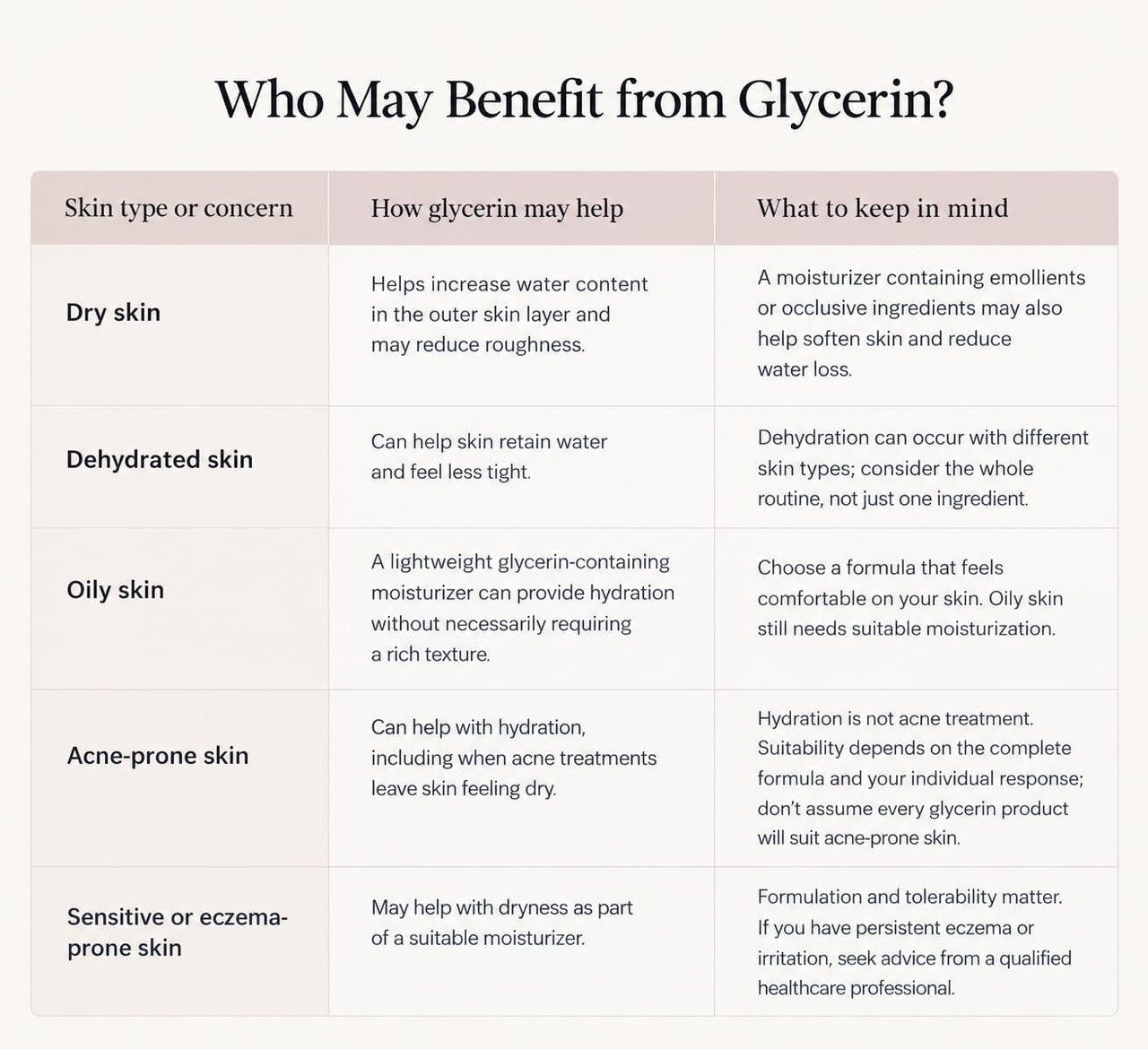
Glycerin can suit different skin types, but the best product depends on your skin’s needs. If you have oily or acne-prone skin, a lightweight, non-comedogenic moisturizer may be a good starting point. If your skin is dry, look for a formula that combines glycerin with ingredients that soften the skin and help reduce moisture loss.
How to Use Glycerin on Your Face
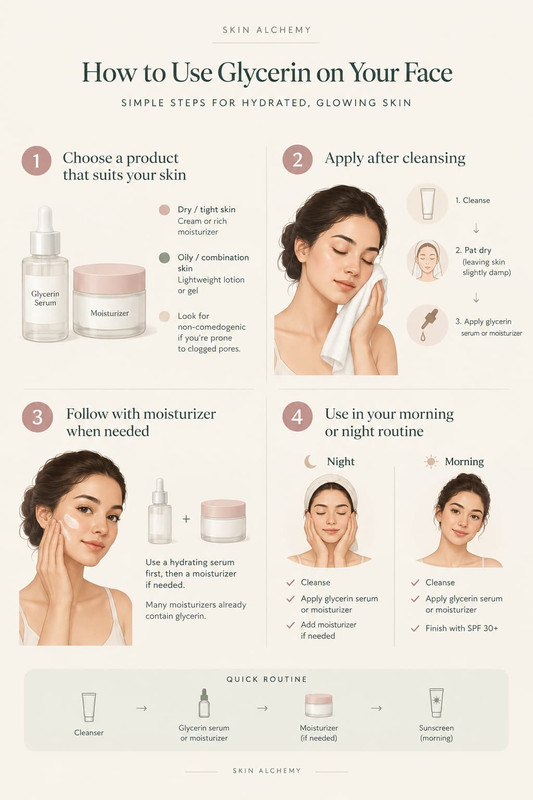
Wondering how to use glycerin on your face for hydrated, glowing skin? For most people, the simplest approach is to use a ready-made moisturizer or hydrating serum containing glycerin rather than preparing a mixture at home.
1. Choose a Product That Suits Your Skin
If your skin feels dry or tight, choose a cream or moisturizer containing glycerin alongside ingredients that soften the skin and help limit moisture loss. If you have oily or combination skin, a lightweight lotion or gel moisturizer may feel more comfortable. Look for a non-comedogenic formula if you are prone to clogged pores.
2. Apply It After Cleansing
Wash your face with a gentle cleanser, then pat your skin lightly with a towel, leaving it slightly damp. Apply your glycerin-containing serum or moisturizer according to the product instructions. Slightly damp skin can help moisturizers retain water, but there is no need to leave your face
3. Follow With Moisturizer When Needed
If you use a hydrating serum, apply your moisturizer afterward to help keep your skin comfortable and reduce moisture loss. Many moisturizers already contain glycerin alongside emollients and occlusive ingredients, so you may not need a separate serum. Choose a combination that suits your skin rather than layering products unnecessarily.
4. Use It in Your Morning or Night Routine
Glycerin-containing products can generally be used in the morning or evening, depending on the product instructions and your skin’s needs. To use glycerin on your face at night, cleanse your skin, apply your glycerin-containing serum or moisturizer, and follow with another moisturizer if needed. In the morning, finish your routine with broad-spectrum sunscreen rated SPF 30 or higher.
5. Can You Use Glycerin Every Day?
Yes, most people can use a well-formulated glycerin-containing moisturizer daily if their skin tolerates it. Start with the product’s recommended frequency, and adjust your routine if you notice irritation or discomfort. Using more products will not necessarily improve hydration.
Learn: Easy Beginner’s Skincare Routine for all Skin Types
Can You Apply Pure Glycerin Directly to Your Face?
Pure glycerin is not the same as a moisturizer formulated with glycerin. Although glycerin is considered safe in cosmetic products when used under the assessed conditions and concentrations, this does not establish that undiluted glycerin is the best choice for direct facial application.
For everyday skincare, a ready-made glycerin-containing moisturizer or serum is the more practical option. Its formulation is designed for skin application, so you do not have to estimate a dilution or experiment with homemade mixtures.

If you’re searching for how to dilute glycerin for facial use, there is no single dilution ratio established as suitable for every person and every preparation. The concentration, ingredients, and final formulation all matter. For routine facial skincare, a finished product designed for skin application is the more straightforward choice.
Glycerin for Skin: Common Concerns About Stickiness, Dryness, Acne and Pigmentation
After learning about the benefits of glycerin, you may still have questions about its stickiness, dryness, breakouts, or dark spots. Here’s what the evidence can—and cannot—tell us.
Why Does Glycerin Feel Sticky?
Glycerin has a naturally thick, slightly tacky texture, so some glycerin-containing products may leave a sticky feeling on the skin. How noticeable this is depends on the product’s concentration, overall formula, and how much you apply.
If your skin feels tacky after application, try using a smaller amount and allowing the product to settle before applying the next step. If the feeling persists, consider switching to a lighter formula. Stickiness doesn’t mean a product is working better. Your moisturizer should leave your skin feeling comfortable, not unpleasantly tacky.

Does Glycerin Dry Out Skin or Make It Dull?
Glycerin is used to help the skin retain moisture, but you may have heard that it can cause dryness in low humidity. The relationship between humidity, glycerin, and skin hydration is more complex than this claim suggests. Available clinical evidence does not establish that glycerin routinely dries out skin in low-humidity conditions.
If your skin feels tight or looks dull after using a product, consider the complete formula and your skincare routine. Harsh cleansers, insufficient moisturization, and irritation can all contribute to discomfort or a dull appearance. Glycerin can help improve skin hydration, but it cannot address every cause of dryness or dullness.
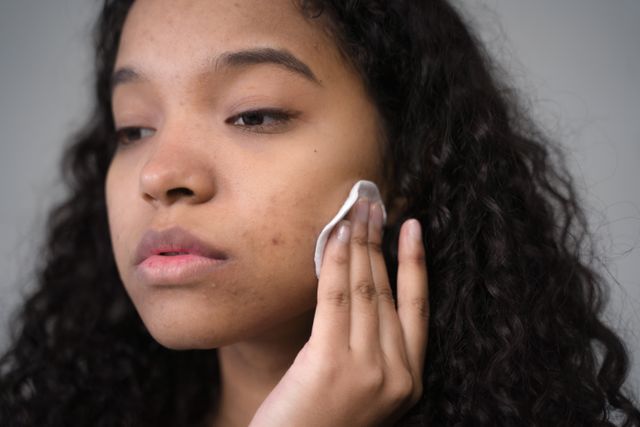
Does Glycerin Cause Acne or Clog Pores?
Current evidence does not establish glycerin itself as a cause of acne. However, that doesn’t mean every product containing glycerin will suit every acne-prone skin type. A study examining naturally occurring glycerol on acne-prone skin does not establish whether applying glycerin in skincare causes or treats acne. The effects of a finished product depend on its full formulation, not just one ingredient.
If you have acne-prone skin, you do not necessarily need to avoid glycerin. Choose a lightweight moisturizer that suits your skin, and pay attention to whether the product appears to worsen your breakouts.
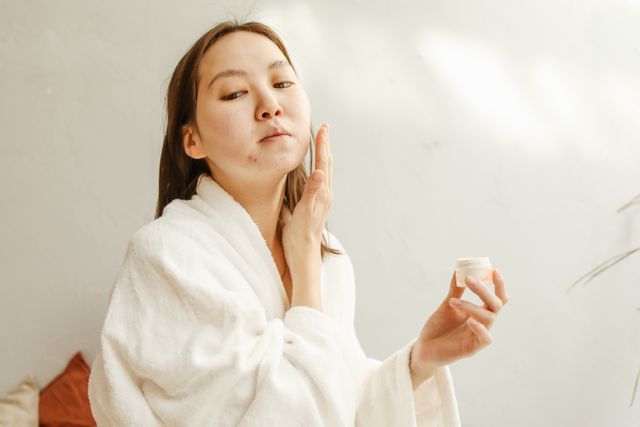
Does Glycerin Darken Skin, Remove Dark Spots, or Fade a Tan?
Glycerin is not an established skin-lightening ingredient, and current evidence does not establish that topical glycerin itself darkens the skin. Its primary role is to improve hydration, not to treat excess pigmentation.
Well-hydrated skin may look smoother and more radiant, but this is different from fading dark spots or removing a tan. A tan develops when the skin produces more melanin in response to ultraviolet (UV) exposure, while dark spots can have several causes.

For pigmentation concerns, use broad-spectrum sunscreen consistently and consider treatments with evidence for your particular concern. Glycerin can complement your routine by keeping the skin moisturized, but it is not an established treatment for tanning or hyperpigmentation.
Read: The Science-Backed Guide to Vitamin C
Do Glycerin and Rose Water Darken the Skin?
There is no established evidence that combining glycerin with rose water inherently darkens the skin. However, there is limited clinical evidence that this homemade mixture provides better hydration than a well-formulated moisturizer.
Rose water may also contain fragrance components that irritate sensitive skin. Adding glycerin to it does not automatically make the mixture suitable for every skin type, and homemade preparations are not tested in the same way as finished cosmetic products. For everyday hydration, a formulated moisturizer or serum is generally the more practical choice.
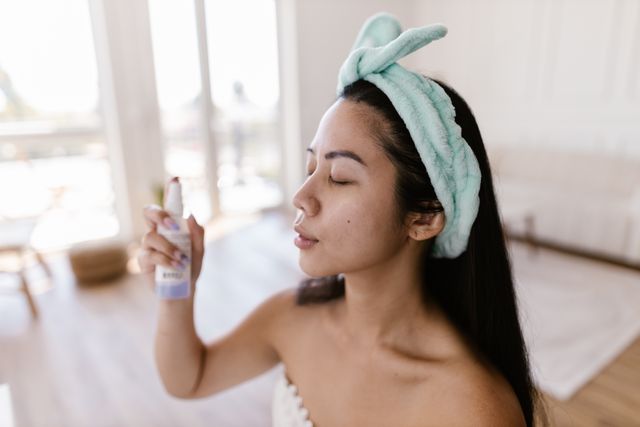
Side Effects of Glycerin on the Face
Glycerin is generally considered safe for cosmetic use under the conditions assessed in safety reviews, but some people may still experience irritation or, rarely, an allergic reaction to an ingredient in a skincare product.
Two possible reactions are worth distinguishing:
- Irritation: Your skin may develop stinging, redness, or discomfort when a product does not agree with it. Other ingredients or the condition of your skin may contribute.
- Allergic contact dermatitis: This is an immune reaction to a substance that can cause itching, redness, and a rash. A published case report has described this reaction associated with a glycerin-containing moisturizer, but a single case cannot tell us how common it is.
If a product causes persistent irritation, stop using it rather than continuing in the hope that your skin will adjust. Seek medical advice if the reaction is severe, does not improve, or keeps returning. Swelling of the lips or tongue, or difficulty breathing, requires emergency medical care.
Key Takeaway:
So, is glycerin good for skin? Yes, its proven benefits include improving skin hydration and helping relieve dryness. Glycerin can suit different skin types when used in a well-formulated moisturizer, but it is not an established treatment for acne, dark spots, or skin lightening. For healthy, hydrated skin, choose a product that suits your skin and focus on what the science supports.
FAQs
Is glycerin good for oily skin?
Yes. Glycerin can hydrate oily skin without requiring a heavy formula. Choose a lightweight moisturizer that suits your skin.
Can you mix glycerin with your moisturizer?
Using a moisturizer that already contains glycerin is the simplest option. Avoid guessing DIY concentrations or preparing homemade mixtures in large batches.
How do you use glycerin on your face at night?
Cleanse your face, apply a glycerin-containing serum or moisturizer, and follow with another moisturizer if needed.
Do dermatologists recommend glycerin?
Glycerin is widely used in moisturizing products recommended for dry skin. The best product depends on your skin’s needs and tolerance.
Can glycerin be used on the lips?
Yes. Glycerin is used in lip-care products to help retain moisture. For chapped lips, choose a formulated balm that also helps protect against moisture loss.
Found this article helpful? Share it with someone you care about.
Stay radiant! Catch you in the next article.
Read More:
Is Glycerin Good for Skin? A Science-Backed Guide to Benefits, Uses & Side Effects
A science-backed guide answering “Is glycerin good for skin?” Explore glycerin benefits for skin, how…

Fall Makeup 2026: Trends, Colors & Easy Looks to Try
The fall makeup guide explores the latest 2026 trends, flattering autumn colors, and easy step-by-step…

Fall Skincare Routine for Glowing Skin: How to Keep Your Skin Hydrated
A practical fall skincare routine guide to building a routine for glowing skin, covering how…

How to Clean Makeup Brushes and Sponges: A Complete Guide 2026
A practical beginner’s guide to ‘how to clean makeup brushes and sponges,’ covering the right…
Why Does My Makeup Look Cakey, Patchy, Dry, or Separated? Here’s How To Avoid Cakey Makeup and Make Foundation Look Smooth
A complete makeup guide to ‘why does my makeup look cakey, ‘ breaking down common causes…

How To Apply Makeup Step-by-Step for Beginners | Beginner Makeup Guide 2026
A beginner’s makeup guide showing how to apply makeup step-by-step for beginners, with the right…
Pingback: Is Vitamin C Good For The Skin? The Complete Guide To Its Benefits, Uses & How It Works (2026)
Pingback: Skincare Ingredients Explained: A Complete Guide (2026)
Pingback: How To Repair Skin Barrier: A Complete 10-Step Science-Backed Guide